The cost of polished concrete flooring in the UK can vary
considerably because the term “polished concrete floor” is used for two
very different types of project. One may involve installing a new
concrete floor that has been designed from the beginning to become the
final visible surface. Another may involve grinding and polishing a
suitable concrete slab that is already in place.
That distinction matters. A new installation includes the concrete
itself and the work required to place, finish, cure and refine it.
Polishing an existing floor avoids the cost of pouring a new slab, but
the condition of that slab can introduce preparation, repair and
coating-removal work that is not immediately visible.
As a broad market guide, current UK cost information commonly places
a newly poured, finished and sealed polished concrete floor at
approximately £120 to £150 per square metre. Polishing a suitable
existing concrete floor is often quoted at around £50 per square metre.
These figures are useful for early budgeting, but they are not a price
list. The final quotation depends on the condition of the floor, the
chosen finish, the size and layout of the area, site access and the
amount of specialist preparation required.
Understanding what sits behind those figures will help you compare
quotations more accurately and avoid choosing a specification that does
not suit the floor or the way the space will be used.
How Much Does a Polished Concrete Floor Cost per Square Metre in the UK?
Published UK pricing guides currently suggest a typical range of £120
to £150 per square metre for a new polished concrete floor that is
poured, finished and sealed. Heidelberg Materials gives the same general
range for a new floor, while Checkatrade currently lists an average of
approximately £135 per square metre.
For a suitable existing slab, Checkatrade gives a broad guide of
around £50 per square metre for polishing. In practice, this figure can
change significantly if the floor has old coatings, adhesive residues,
cracks, contamination, surface damage or variations that must be
addressed before polishing begins.
These headline figures do not always describe the same scope of work.
One quotation may include preparation, repairs, edge work,
densification, polishing and protection. Another may cover only the main
grinding and polishing stages. A meaningful comparison therefore needs
to look beyond the rate per square metre and examine exactly what is
included.
For a reliable project figure, the contractor needs to understand
both the existing substrate and the finish you expect. This is why a
site survey is much more useful than applying an online average to the
floor area.
New Polished Concrete Installation vs Polishing an Existing Slab
The most important pricing decision is whether the project needs a
new concrete installation or can make use of the slab already
present.
Cost of a New Polished Concrete Floor
A new installation gives greater control over the floor specification
from the outset. The concrete mix, placement method, colour, aggregate,
finishing process and intended amount of aggregate exposure can all be
considered before work starts.
The process generally involves preparing the base, installing the
specified concrete system, placing and finishing the concrete, allowing
sufficient curing time and then completing the required grinding,
polishing and protective treatment. Each stage affects both the
appearance and long-term performance of the floor.
The headline price may therefore include much more than polishing.
Concrete supply, pumping or placement, reinforcement requirements,
access, floor thickness, finishing around edges and curing conditions
can all influence the total. Decorative aggregates, pigments and more
demanding visual specifications can also increase the cost.
For clients starting a new build, extension or substantial
refurbishment, planning the professional
polished concrete installation early can prevent expensive changes
later. Door thresholds, adjoining finishes, underfloor heating, service
locations and final floor height should all be considered before the
concrete is poured.
Cost of Polishing an Existing Concrete Floor
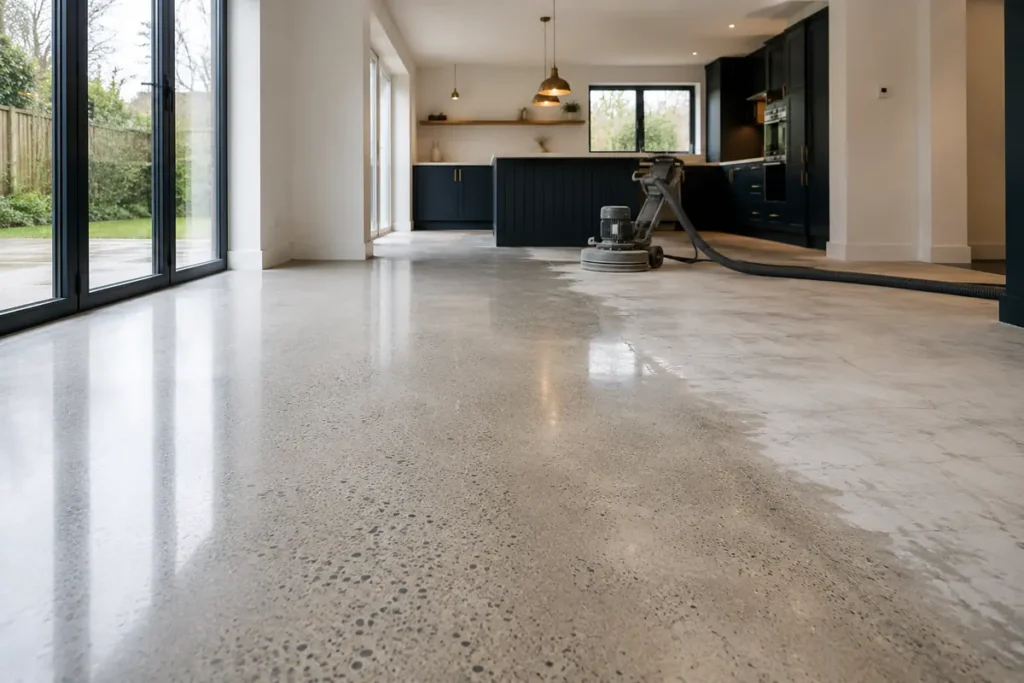
Polishing an existing slab can be a more economical route because the
main concrete floor is already in place. The surface is mechanically
ground using specialist diamond tooling, refined through progressively
finer stages and treated to achieve the required finish and
protection.
However, an existing slab was not always poured with its final
appearance in mind. Its aggregate distribution, previous repairs,
cracks, surface marks and colour variations may become more visible
during grinding. These natural characteristics can give polished
concrete its distinctive appearance, but they also mean that an exact
visual result cannot be guaranteed from a surface inspection alone.
Before recommending that a contractor grind
and polish concrete, the slab should be assessed for soundness,
flatness, moisture, contamination, previous coatings and the likely
depth of grinding. A floor that appears inexpensive to polish can
require substantial preparation once an old covering or coating is
removed.
When the slab is suitable, retaining and refining it can reduce
material use, shorten the active installation programme and create a
durable finished surface without covering the concrete with another
flooring material.
What Affects the Cost of Polished Concrete Flooring?
The square metre rate provides a useful starting point, but the
following project conditions usually determine the actual quotation.
Floor Size and Layout
Larger open areas are generally more efficient to grind and polish
than several small rooms with the same combined floor area. Small
spaces, narrow sections, columns, fixed equipment, corners and changes
in floor height require more detailed edge work and slower machine
movement.
Minimum project or mobilisation costs can also make the rate per
square metre appear higher for a compact area. The machinery, dust
control, tooling and specialist team must still be transported and
prepared even when the floor itself is relatively small.
Existing Floor Condition
A sound, reasonably flat and accessible slab will usually require
less corrective work than a floor with deep wear, failed repairs, holes
or widespread damage. Cracks do not automatically prevent polishing, but
their cause and stability should be assessed before a repair method is
chosen.
Some repairs can be incorporated into the finished character of the
floor. Others may remain visible after polishing. An experienced
contractor should explain what can be improved, what will remain part of
the surface and when it would be more appropriate to restore
an existing concrete floor before the final polishing stages.
Removal of Coatings and Residues
Paint, epoxy, adhesives, curing compounds, oils and other residues
can interfere with grinding, polishing or protective treatments.
Removing them requires additional tooling, labour and waste
handling.
The extent of contamination is not always obvious before work begins.
A trial area can help establish how the coating responds, how deeply a
stain has penetrated and what the concrete looks like beneath the
existing finish.
Correct specialist
concrete floor preparation is not an optional extra. It is the
foundation for a consistent finish and can prevent adhesion, staining
and performance problems later.
Desired Aggregate Exposure
The depth of grinding determines how much aggregate is visible. A
light grind may reveal fine particles and create a subtle
salt-and-pepper appearance. A deeper grind exposes larger aggregate and
produces a more pronounced decorative effect.
Deeper exposure usually requires more grinding stages, tooling and
time. The original placement of the concrete also affects how evenly the
aggregate appears across the floor. This is particularly important with
existing slabs because the surface was not necessarily designed for
decorative exposure.
Sheen and Refinement Level
A matt or low-sheen finish may require fewer refinement stages than a
highly polished surface. Higher clarity and reflectivity normally
involve progressively finer diamond tooling and closer attention to the
consistency of each stage.
The best finish is not automatically the glossiest one. Residential
interiors, retail premises, warehouses and industrial environments have
different requirements for appearance, maintenance and slip resistance.
The finish should be specified around how the floor will actually be
used.
Edge Work and Detailed Areas
Large machines cannot reach every edge, doorway, corner or fixed
obstruction. These sections are completed with smaller equipment and
hand-controlled tooling. A floor with many detailed areas can therefore
take longer than an open rectangular space of the same size.
Good edge work matters because inconsistent refinement around the
perimeter remains visible when the main floor is complete. It should be
included clearly in the proposed scope rather than treated as an
assumption.
Site Access and Project Programming
Restricted access, upper-floor locations, occupied buildings, limited
working hours and phased programmes can all affect cost. Commercial and
industrial work may need to be arranged around other trades, stock,
machinery or business operations.
A clear programme allows the contractor to plan equipment, dust
control, drying or curing periods and protection of the completed
surface. Rushed sequencing can compromise both appearance and
durability.
Sealers, Densifiers and Protective Treatments
The finished surface may require a densifier, impregnating treatment,
stain protection or another system suited to the concrete and its
environment. Product selection should reflect the expected traffic,
exposure to spills, cleaning regime and desired appearance.
The cheapest treatment is not always the most economical over the
life of the floor. A correctly specified system can reduce staining,
simplify maintenance and help the polished finish retain its
clarity.
Is Polishing an Existing Concrete Floor Always Cheaper?
It is often cheaper, but not in every situation.
An existing slab can offer a strong cost advantage when it is sound,
accessible and free from extensive coatings or damage. In this
situation, the main work may be limited to controlled grinding, repairs
where appropriate, progressive polishing and surface protection.
The calculation changes when substantial removal or correction is
required. Failed epoxy, thick adhesive, oil contamination, extensive
repairs or major surface variation can add several preparation stages.
There may also be visual limitations that only become clear after the
first grinding pass.
A new installation costs more at the beginning, but it offers greater
control over the build-up and decorative result. Where an existing floor
is unsuitable, repeatedly trying to correct it can be less sensible than
installing a properly specified new system or overlay.
The right comparison is therefore not simply “new floor versus £50
per square metre”. It is the total cost of achieving a suitable, durable
result from the substrate available.
Can Every Existing Concrete Floor Be Polished?
Many existing floors can be polished, including surfaces that
initially look dull, worn or unattractive. Professional grinding can
remove the weak or damaged upper layer, expose sound concrete and create
a much more uniform surface.
Suitability still needs to be confirmed. The assessment should
consider structural condition, cracks, moisture, previous treatments,
contamination, floor thickness and the expected use of the space. Some
imperfections can be repaired and incorporated into the finished floor.
Others may indicate a deeper issue that polishing alone will not
resolve.
It is also important to accept the natural character of an existing
slab. Aggregate exposure, colour and historic repairs may vary. Polished
concrete is not a printed surface, and that variation is often part of
its appeal. Clients who require a highly controlled colour or aggregate
layout may be better suited to a newly installed decorative concrete
system.
Is a Polished Concrete Floor Worth the Cost?
Polished concrete can provide long-term value because the structural
floor becomes the finished surface. There is no separate tile, timber,
vinyl or carpet layer to purchase and install over it. A correctly
specified floor can withstand demanding traffic and remain serviceable
for many years.
Maintenance is relatively straightforward, but the floor is not
maintenance-free. Dry soil should be removed regularly, spills should be
cleaned promptly and suitable cleaning products should be used. Harsh
chemicals or neglected abrasive dirt can affect the appearance of any
finished surface.
Polished concrete also works well with contemporary interiors and
underfloor heating. Its thermal mass can help distribute heat, although
the complete floor and heating build-up must be designed correctly. In
commercial and industrial settings, the hard-wearing surface and ease of
cleaning can make it a practical alternative to applied coverings or
coatings.
The value depends on specification and workmanship. A low quotation
that excludes preparation, detailed edge work or the correct finishing
stages can create higher rectification costs later. Comparing the
complete proposed system is more useful than selecting the lowest
headline rate.
How to Obtain an Accurate Polished Concrete Floor Quote
Start with the floor area, property location, intended use and
preferred appearance. For an existing slab, provide information about
previous coverings, coatings, known repairs and any contamination.
Photographs are useful for an initial conversation, but they cannot
replace a physical assessment where the floor condition is
uncertain.
During a site survey, the contractor can inspect access, edges,
cracks, surface consistency and the likely preparation requirements. The
discussion should also cover aggregate exposure, sheen, protective
treatment, programme and ongoing maintenance.
The quotation should state whether it includes preparation, repairs,
grinding stages, edge work, polishing, protection and waste removal.
This makes it easier to understand why two rates may differ and whether
they are genuinely based on the same outcome.
Concrete & Stone Solutions works across residential, commercial
and industrial environments, providing tailored guidance for new
installations and existing concrete floors. To understand which route
suits your project and receive a specification based on the actual
surface, book a
free site survey.
Frequently Asked Questions
How much does a polished concrete floor cost per square metre
in the UK?
Current UK market guides commonly suggest approximately £120 to £150
per square metre for a new floor that is poured, finished and sealed.
Polishing a suitable existing slab is often quoted at around £50 per
square metre. Actual costs vary according to preparation, floor
condition, finish, area and access.
Why is a new polished concrete floor more
expensive?
A new floor includes the concrete installation as well as the
finishing process. Base preparation, concrete supply, placement,
reinforcement requirements, curing, grinding, polishing and protection
may all form part of the project.
Can an old concrete floor be polished?
Many old concrete floors can be restored through grinding and
polishing. The slab should first be assessed for soundness, cracks,
moisture, contamination and previous coatings. A trial area may be
recommended where the likely appearance or preparation requirement is
uncertain.
Will cracks disappear when concrete is polished?
Grinding and polishing do not make every crack disappear. Suitable
cracks may be repaired, but repairs can remain visible and become part
of the floor’s character. Active or structurally significant cracking
should be investigated before cosmetic work begins.
Does the amount of shine affect the cost?
Yes. A higher sheen and greater visual clarity usually require more
refinement stages with progressively finer diamond tooling. The chosen
finish should also take account of maintenance, traffic and
slip-resistance requirements.
Can polished concrete be used with underfloor heating?
Yes. Concrete works well with underfloor heating because it can
absorb and release heat across the floor. The heating system, slab and
final finish must be designed and commissioned correctly to manage
performance and movement.
How long does polished concrete flooring take to complete?
The active grinding and polishing period depends on the area,
condition and specification. A new floor also requires an appropriate
curing period before final refinement. Site access, repairs, coatings
and phased working can extend the programme, so timing should be
confirmed after assessment.
Do I need a site survey before receiving a quote?
A specialist may be able to provide an initial indication from
measurements and photographs, but a site survey gives a much more
reliable basis for pricing. It allows the contractor to assess the
substrate, access, edge work, preparation and likely finish before
confirming the scope.