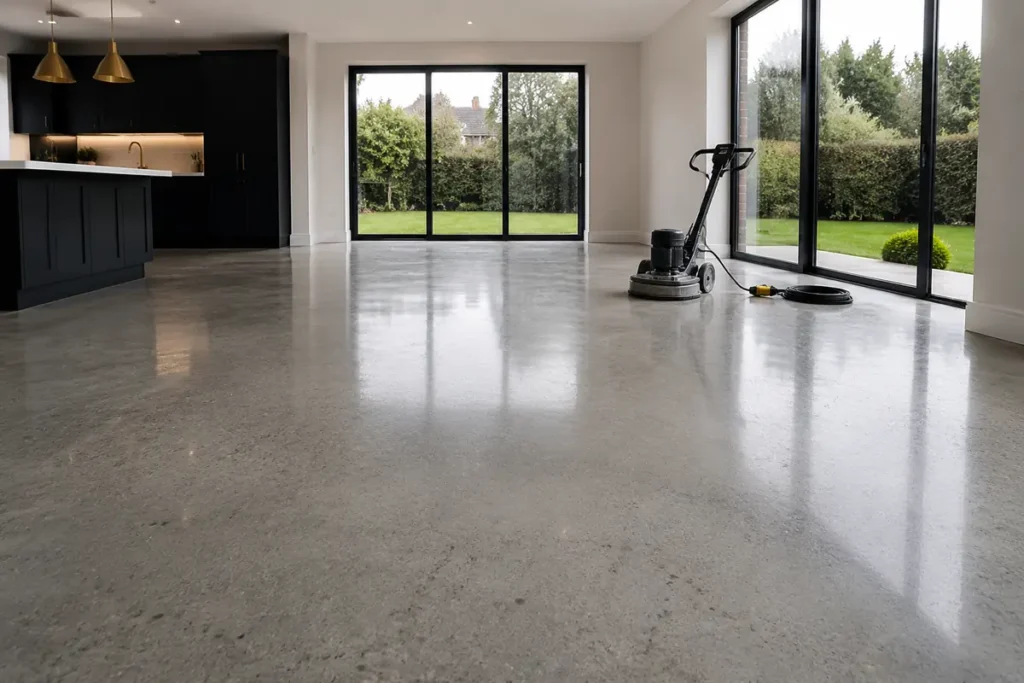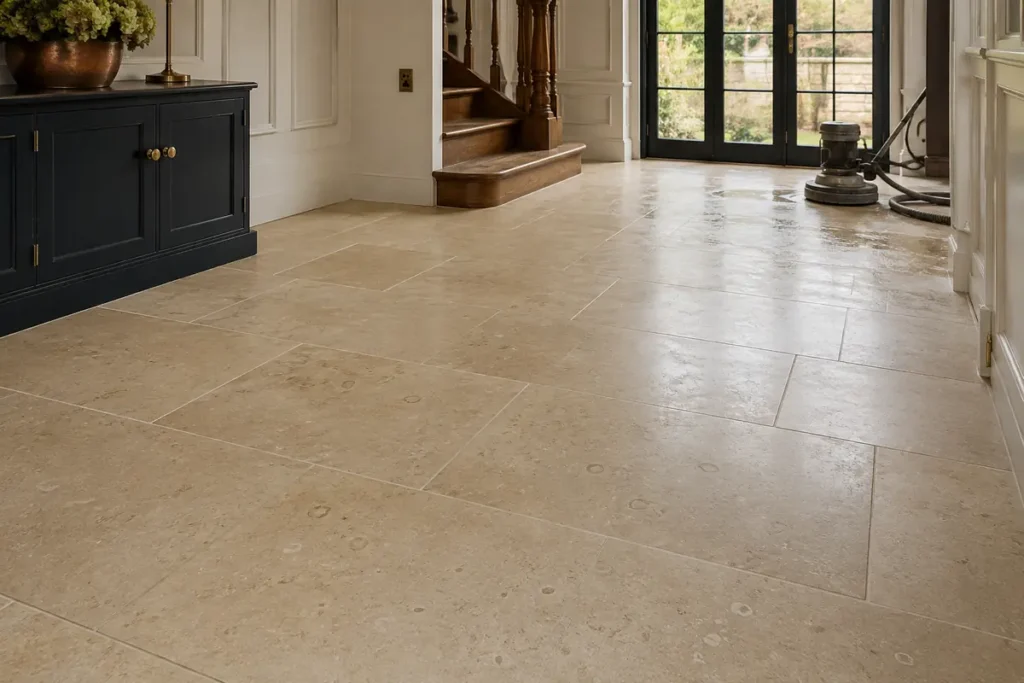
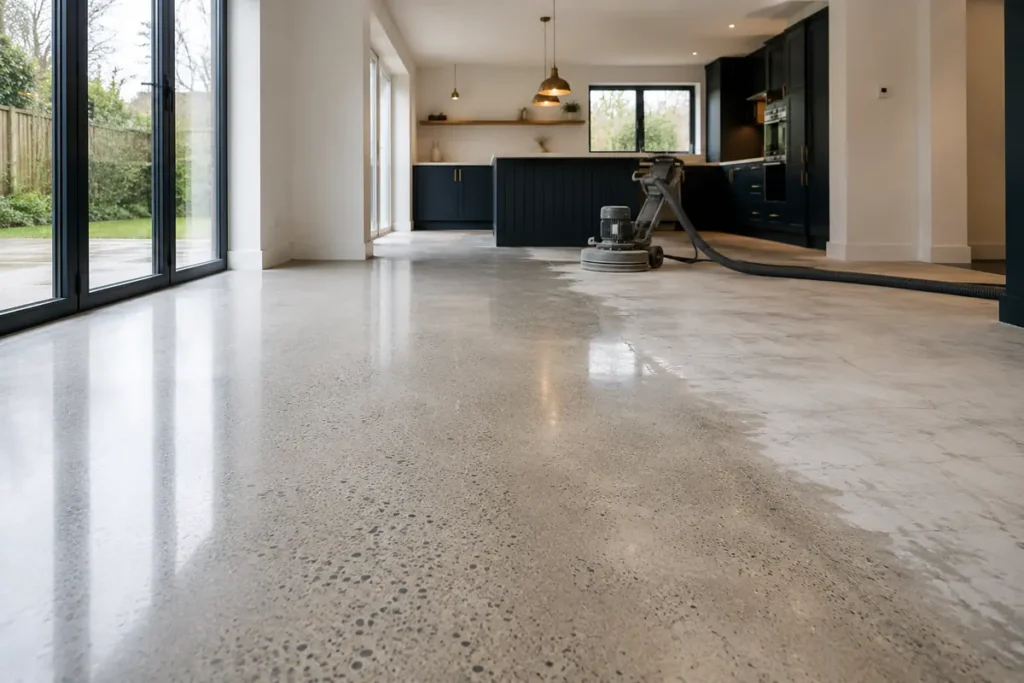
Yes, many existing concrete floors can be polished without being
replaced. A sound slab can often be repaired, mechanically ground and
progressively refined to create a durable, attractive finished surface.
However, polishing is not a cosmetic treatment that hides every defect.
It reveals and refines the concrete already present, so the quality,
history and condition of that slab directly influence the result.
This distinction is important when a floor is covered by tiles,
carpet, vinyl, resin or an old coating. Removing the covering may expose
concrete that appears rough, stained or cracked, but that does not
automatically make the slab unsuitable. Adhesive residues can often be
removed, local defects may be repairable and an uneven surface can
sometimes be improved through controlled grinding. In other cases,
hidden moisture, extensive movement or widespread deterioration may mean
that polishing the original floor would not provide a reliable or
visually acceptable outcome.
The right starting point is therefore not an assumption that the
floor must be replaced. It is a proper assessment of the exposed
concrete. Concrete & Stone Solutions provides professional
concrete grinding and polishing for residential, commercial and
industrial floors, with the specification based on the actual slab
rather than a standard process applied to every project.
The Short Answer: Can Old Concrete Be Polished?
The age of a concrete floor does not, by itself, determine whether it
can be polished. An older slab may be dense, stable and entirely
suitable for restoration, while a newer floor may have weak surface
laitance, poor finishing, excessive cracking or inconsistent levels that
complicate the work.
What matters is whether the concrete has sufficient integrity to
withstand mechanical preparation and support the intended use. The
surface must also be accessible so that coatings, adhesives and
contamination can be assessed rather than simply polished over.
If the slab is fundamentally sound, the normal route may involve
removing existing materials, repairing appropriate cracks and defects,
grinding the surface to the agreed aggregate exposure, densifying the
concrete where required and refining it through progressively finer
abrasives. Edge work, joints and transitions are treated as part of the
floor rather than as an afterthought.
The finished appearance will still reflect the character of the
original concrete. Previous repairs, aggregate distribution,
construction joints, cracks and colour variation may remain visible. For
many clients, these features are part of the honest industrial or
architectural appeal of polished concrete. If a highly uniform
decorative finish is essential, a new polished concrete installation or
suitable overlay may offer greater control.
What Specialists Check Before Polishing an Existing Slab
A site survey is not simply used to measure the floor area. It helps
establish whether the slab is a suitable base, what preparation is
needed and what finish can realistically be achieved. The assessment
should consider the following factors together, because no single test
or visual observation tells the whole story.
Structural Condition and Surface Soundness
The first question is whether the concrete is stable and sound. A
floor with minor shrinkage cracks or isolated surface defects may still
be suitable, but widespread breakup, loose sections, severe spalling or
signs of continuing movement require closer investigation.
Grinding removes and refines a controlled amount of the upper
surface. It cannot restore structural capacity to concrete that has
failed through its depth. Where damage may be structural, a competent
engineer or other appropriate specialist may need to assess the slab
before a flooring specification is agreed.
Surface hardness also matters. Weak or dusty concrete may not respond
in the same way as a dense, well-finished slab. Local testing and a
small trial area can reveal how the floor cuts, whether the surface is
consistent and how much aggregate exposure is likely.
Cracks, Joints and Previous Repairs
Cracks do not automatically rule out polishing. Some stable cracks
can be cleaned, repaired and incorporated into the finished floor. The
repair material must be compatible with the intended grinding and
polishing process, and the repaired line may remain visible after
completion.
The more important issue is why the crack occurred and whether
movement is continuing. A crack that is stable is different from one
caused by ongoing settlement, thermal movement or another unresolved
condition. Polishing cannot prevent a moving crack from reopening.
Construction joints, movement joints and saw cuts also need an
appropriate treatment. They should not simply be covered in an attempt
to make the floor look seamless. Their function, condition and
relationship with the planned finish must be understood before work
begins.
Moisture and Contamination
An existing floor may have been exposed to oils, chemicals, moisture
or cleaning products for years. Some contamination remains close to the
surface and can be removed during preparation. Other substances
penetrate more deeply and may continue to affect colour, repairs or
protective treatments.
Moisture is equally important. Visible damp, efflorescence, an absent
or ineffective damp-proof membrane, leaks and changes in site conditions
all need consideration. A polished concrete system is different from a
film-forming floor covering, but that does not mean moisture can be
ignored. It can influence the appearance of the slab and the performance
of certain treatments used during the process.
A contractor should understand the source and extent of the problem
before specifying the floor. Covering uncertainty with a topical product
is not a substitute for investigating it.
Existing Coatings, Adhesives and Floor Coverings
Paint, resin, tile adhesive, bitumen, carpet glue and levelling
compounds can hide the actual condition of a slab. They normally require
removal through suitable professional
concrete floor preparation before the concrete can be properly
evaluated and polished.
Removal may reveal shadowing, staining, fixing holes or differences
in the surface where previous finishes were installed. Adhesives can
also penetrate pores or react differently across the floor. A test area
helps establish the likely preparation effort and whether residual marks
will suit the expected appearance.
It is rarely sensible to promise a perfectly uniform floor while the
slab remains concealed. The most reliable specification is developed
after exposure or through representative trial areas.
Flatness, Levels and Surface Variation
Grinding can improve minor high points and create a more consistent
surface, but it should not be confused with structural levelling.
Correcting significant variations may require removing too much concrete
from certain areas, potentially exposing aggregate unevenly or reducing
cover above reinforcement and services.
The existing flatness also affects the visual result. A grinder makes
more contact with high areas first, so those areas may show deeper
aggregate exposure than lower sections. This is one reason an old slab
can produce natural variation even when the same process is applied
across the floor.
Door thresholds, skirtings, fixed equipment, drainage falls and
adjoining floor finishes must also be considered. The aim is not merely
to make the concrete shine. It is to create a practical floor that works
within the whole space.
Slab Thickness, Reinforcement and Embedded Services
Before deeper grinding is specified, the available concrete thickness
and the position of reinforcement, underfloor heating pipes or other
embedded services may need to be considered. Polishing usually refines
the upper surface rather than removing a large depth, but deeper
aggregate exposure and corrective grinding require a more cautious
approach.
If reliable construction information is unavailable, expectations
should be conservative until the floor has been assessed. The presence
of underfloor heating does not automatically prevent polishing, but the
system location, slab construction and condition must be understood
before work begins.
Aggregate Distribution and Expected Appearance
An existing structural slab was not necessarily poured as a
decorative finished floor. Aggregate may be distributed unevenly,
separate pours may have different colours, and previous repairs may
appear more clearly after grinding. These are characteristics of the
concrete, not necessarily faults in the polishing work.
Clients who want a natural, individual surface often value this
variation. Clients seeking a highly controlled aggregate pattern and
consistent colour may be better served by a new
polished concrete floor installation designed with the finished
appearance in mind.
Agreeing expectations before work starts is therefore as important as
confirming technical suitability.
Which Problems Can Be Repaired Before Polishing?
Many common defects can be improved as part of specialist
concrete floor restoration, provided the underlying slab remains
suitable. These may include stable cracks, small holes, local spalling,
worn areas, minor surface irregularities and damage left by previous
floor coverings.
Repairs should be treated as part of the visual specification. A
repair compound can support the performance of the floor and allow the
surface to be refined, but it will not always disappear into the
surrounding concrete. The repaired area may differ in colour or texture,
particularly where the existing slab has aged or contains varied
aggregate.
Old fixing points and service channels can sometimes be filled and
polished, although their outlines may remain visible. Local staining may
reduce during grinding, but deeply absorbed oil, rust or chemical marks
may not be removable without taking away an unreasonable amount of
concrete. In such cases, retaining some variation can be safer and more
honest than over-grinding the floor in pursuit of a perfect colour.
Small areas of weak surface material can sometimes be removed to
expose stronger concrete below. Widespread weakness is a different
problem and may point towards a topping, overlay or replacement rather
than continued grinding.
What Finish Can Be Achieved on Existing Concrete?
An existing floor can often be finished from a low-sheen, lightly
refined surface to a more highly polished result. Sheen and aggregate
exposure are related but separate decisions. A floor can have deeper
aggregate exposure with a satin appearance, or lighter exposure with a
higher level of refinement, subject to the condition and consistency of
the slab.
Cream or Power-Floated Finish
A cream finish preserves more of the fine material at the surface and
reveals little or no coarse aggregate. It depends heavily on the quality
and uniformity of the original placement and finishing. On an old floor,
wear, coatings, damage and surface variation may make a consistent cream
finish difficult or impossible to achieve.
This option should only be promised after the exposed floor has been
carefully assessed. If the surface requires extensive corrective
grinding, the process will naturally move beyond a true cream
appearance.
Salt and Pepper or Light-Grind Finish
A light grind removes the upper surface and reveals fine aggregate,
producing the scattered appearance often called salt and pepper. It can
be a practical option where the slab is reasonably flat and consistent,
but high and low areas may create variable exposure.
The result can look refined while retaining the character of the
original concrete. Trial grinding is particularly useful when the client
wants light exposure without a heavily industrial appearance.
Full-Exposure or Deeper-Grind Finish
Deeper grinding reveals more of the coarse aggregate within the slab.
This can create a bold decorative finish and may help address greater
surface variation, but it also makes the concrete’s internal composition
more visible.
Aggregate size, colour and distribution cannot be redesigned after
the slab has cured. Separate pours, repairs and high spots may all
produce variation. Deeper grinding also needs careful control around
edges, thresholds, reinforcement and embedded services.
Matte, Satin or Higher-Sheen Polishing
The agreed sheen should reflect the intended use, maintenance
expectations and desired appearance. Higher gloss is not automatically
the best specification for every environment. A well-refined matte or
satin finish may be more appropriate for some homes, workspaces or
industrial areas.
The polishing sequence progressively refines the scratches left by
the previous stage. Simply applying a shiny coating is not equivalent to
mechanically polished concrete. The quality of the finished surface
depends on controlled grinding, honing, polishing and any specified
densification or protection.
When Is Polishing the Existing Floor the Best Option?
Retaining the slab is often the most practical route when the
concrete is stable, defects are repairable and the client accepts that
the final surface will express the history of the floor. It can avoid
the disruption, waste and additional build-up associated with removing
sound concrete and installing a completely new slab.
Existing-floor polishing can work particularly well in warehouses,
workshops, retail units, offices, restaurants and residential
renovations where durability and a distinctive material finish are
priorities. It may also reduce the need to introduce another floor
covering over a usable structural base.
The decision should still be based on total scope rather than floor
area alone. Coating removal, edge work, crack repairs, access
restrictions and the required finish all affect the programme and
quotation. Our guide to polished
concrete flooring costs explains why two floors of the same size can
require very different levels of work.
When Is a Polished Overlay More Suitable?
A suitable cementitious overlay or decorative topping may be
considered when the original slab is stable but cannot deliver the
visual finish required. For example, the concrete may contain extensive
patching, inconsistent pours, deep staining or aggregate that does not
suit the design.
An overlay can provide greater control over colour and aggregate
selection without necessarily removing and rebuilding the structural
slab. However, it is not a shortcut around poor preparation. The
substrate still needs to be sound, appropriately prepared and compatible
with the chosen system. Cracks, movement, moisture and transitions must
still be assessed because problems in the base can affect the new
surface above.
The overlay also changes floor height. Doors, thresholds, stairs,
fixtures and adjoining rooms may need to be considered as part of the
specification.
When Does a Concrete Floor Need Replacing?
Replacement becomes more likely when the slab has failed beyond
practical surface repair. Examples include widespread breakup, severe
delamination, continuing movement, major settlement, extensive
contamination through the depth of the concrete or a slab that does not
meet the structural and operational needs of the space.
It may also be the better route where significant changes to
drainage, levels, insulation, underfloor heating or load capacity are
required. In those cases, replacing or redesigning the floor is not
being recommended simply to improve its appearance. It is necessary to
resolve limitations that surface grinding cannot correct.
The key point is that visible wear alone does not prove replacement
is needed. Conversely, making a damaged slab look smoother does not make
it structurally sound. The assessment must distinguish between surface
defects that can be restored and underlying failures that require a
different construction solution.
What Happens During the Grinding and Polishing Process?
Once the scope has been agreed, the floor is cleared and any existing
coverings or coatings included in the work are removed. The exposed slab
is then reassessed, because concealed cracks, repairs and contamination
can only be understood properly once they are visible.
Initial grinding is selected according to the hardness of the
concrete, the material being removed and the required aggregate
exposure. The floor is processed in controlled stages rather than being
taken directly from rough concrete to a glossy finish. Repairs, joint
treatment and pore filling are completed at appropriate points so they
integrate with the wider process.
Further honing and polishing stages progressively refine the scratch
pattern. A densifier may be applied where specified to react within the
concrete and support a harder, more refined surface. Edge work is
completed using suitable equipment so that the perimeter relates
properly to the main field of the floor.
The final protection and burnishing stages depend on the intended use
and agreed system. A protective treatment can improve resistance to
everyday spills, but polished concrete is not completely stain-proof.
Prompt cleaning and appropriate maintenance remain important,
particularly in kitchens, hospitality spaces, workshops and other areas
where contaminants may be present.
Why a Trial Area Can Be Worthwhile
On an uncertain existing slab, a trial area provides more useful
information than judging the floor only from photographs. It can show
how easily coatings are removed, how hard the concrete is, what
aggregate appears below the surface and how repairs or stains may
influence the result.
A sample does not guarantee that every part of a large floor will
look identical. Different pours and varying levels may still produce
changes across the space. It does, however, allow the contractor and
client to discuss the likely character of the finished floor using real
evidence from the project.
This is particularly valuable when the floor has been covered for
many years or when the desired finish is highly specific.
Should You Polish, Overlay or Replace Your Floor?
The answer depends on two questions: what condition is the slab in,
and what result do you expect from it?
If the concrete is sound and natural variation is acceptable, repair
and polishing may preserve the existing structure while creating a
durable finished floor. If the slab is stable but aesthetically
unsuitable, an overlay may provide greater design control. If the
concrete has significant structural, moisture or movement-related
problems that cannot be resolved through surface work, replacement may
be necessary.
Choosing between these routes without seeing the floor can lead to
unrealistic budgets or expectations. Concrete & Stone Solutions
assesses residential, commercial and industrial projects before
recommending a process. To understand what your existing slab can
support, book a
free site survey.
Frequently Asked Questions
Can any existing concrete floor be polished?
No. Many existing floors can be polished, but the slab must be
sufficiently sound and suitable for mechanical preparation. Structural
failure, severe movement, widespread weak concrete or deep contamination
may require a different solution.
Can a cracked concrete floor still be polished?
Some stable cracks can be repaired and incorporated into the finish.
The repair may remain visible, and polishing cannot stop a crack from
reopening if the underlying movement continues. The cause and condition
of the crack should be assessed first.
Can painted or coated concrete be polished?
Potentially, yes. The coating must normally be removed so the
concrete beneath can be evaluated and processed. Removal may reveal
staining, adhesive residue, repairs or surface variation that affects
the final appearance and price.
Can an uneven concrete floor be ground flat and
polished?
Minor high points and surface irregularities may be improved through
grinding. Significant level differences are more complex because
excessive grinding can create uneven aggregate exposure or affect the
depth above reinforcement and services. A survey is needed to determine
what is practical.
Will polishing hide stains and old repairs?
Not necessarily. Grinding may reduce some surface staining, but deep
contamination and previous repairs can remain visible. Polishing refines
the existing concrete rather than covering it with an opaque new
layer.
Can concrete with underfloor heating be
polished?
It may be possible, but the slab construction, heating system
location, available depth and floor condition must be understood before
grinding. Construction records and a careful site assessment help reduce
risk.
Is polishing an existing slab cheaper than replacing
it?
It often can be, but not always. The comparison depends on coating
removal, repairs, contamination, edge work, access and the required
finish. A heavily damaged floor may require enough preparation that an
overlay or replacement becomes more appropriate.
How long does it take to polish an existing concrete
floor?
The programme depends on floor size, condition, access, repairs,
coating removal and the polishing specification. A clear timescale can
only be provided after the existing surface and project requirements
have been assessed.
Do I need a site survey before deciding?
Yes. A survey helps determine whether the floor is suitable, which
defects can be repaired, what appearance is realistic and whether
polishing, an overlay or replacement offers the best route.